
We started noticed as a networking agent. The idea was simple: understand what you are trying to achieve, remember the people around you, and help you use those relationships when it matters.
Then Simão and I did what we had spent the previous decade learning to do: we surrounded it with software.
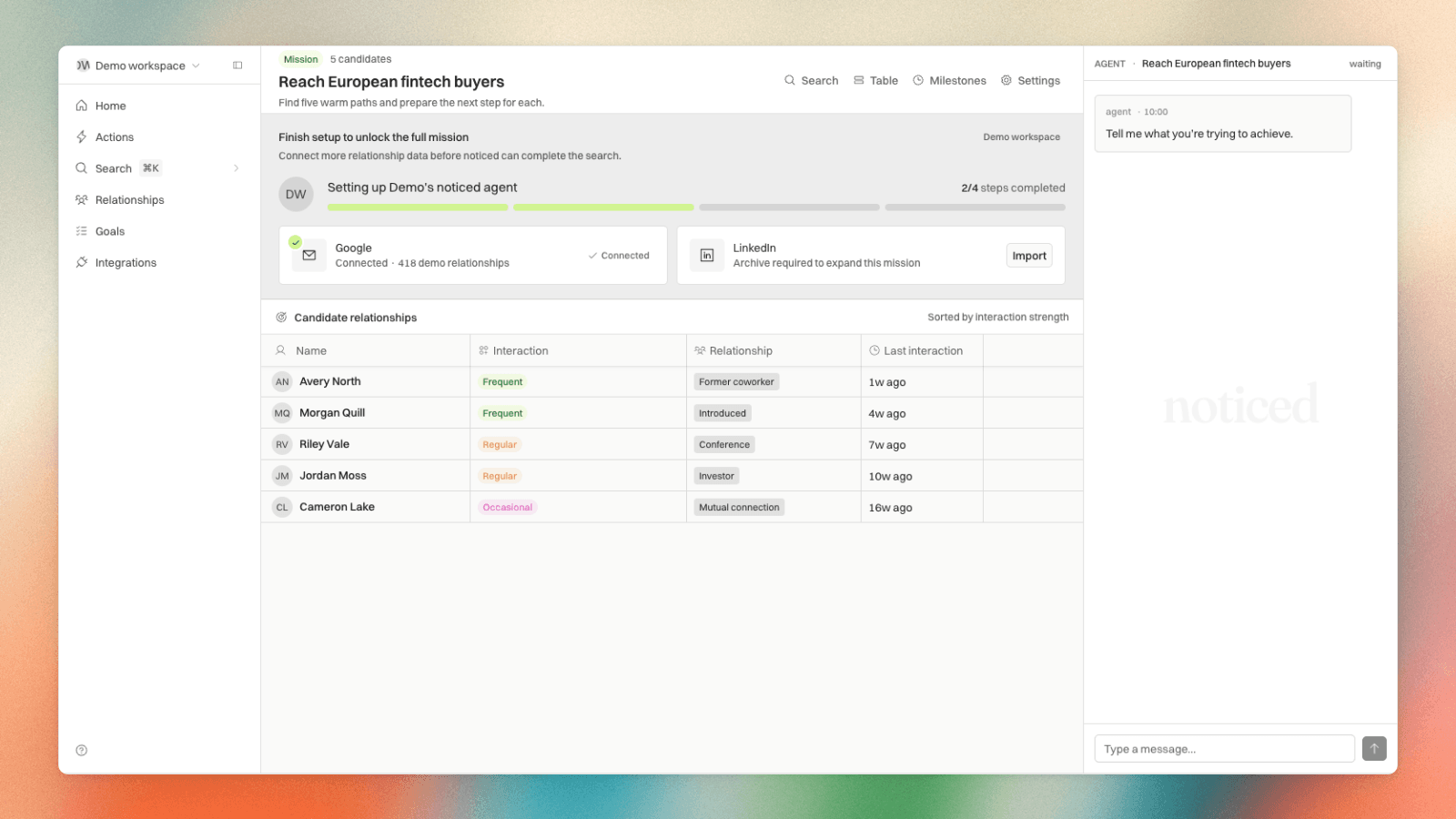
Every problem became another screen. People needed to connect data, so we built connector flows. They needed to see what noticed knew, so we built relationship pages, tables, search, missions, and settings. They needed to get through setup, so we built onboarding steps, unlocks, and progress bars.
That software was useful. It gave people visibility and control while our models and data were weaker. It also showed us what people wanted to know about their network and where they needed to correct us.
But we also asked for too much upfront. Before seeing any value, people had to learn new concepts, connect several accounts, give noticed access to a lot of relationship data, and trust that we would use it well. Many did not fully understand what they were setting up or what the data would do for them.
Once we added all those screens together, we had changed the division of work. People connected the sources, answered the questions, chose the next step, navigated the pages, and interpreted the relationship data. The networking agent waited for instructions.
The software helped us learn, but that does not mean every part of it deserves to remain in the product.
You don’t learn the product, it learns from you
Traditional onboarding asks you to learn the product. noticed does the opposite: it learns from you.
We’re rebuilding the early experience around one conversation, with no distractions, fewer concepts to learn, and an agent that guides the work.
Instead of having to learn the product, you can focus on solving a real relationship problem. By watching noticed work, you see what it can do, and from your corrections, noticed learns about your goals, relationships, and judgment.
Each request for more data should pay off immediately. If you connect LinkedIn, noticed should immediately show you something you could not see before, like which people you already know at the companies you want to reach. If it asks a question, the answer should improve the work in front of you.
noticed learns from your feedback
Traditional software gives you tools and expects you to do the work. An agent can take on more of that work for you. You tell noticed what you are trying to achieve. It searches your network, prepares a recommendation, and explains why it chose those people. You approve it, reject it, or correct it.
That feedback does more than improve one recommendation. It is how we’re building the first AI models for professional relationships.
noticed already resolves identities across sources, tracks interaction history, and estimates relationship strength. The data can still miss the truth: a relationship may matter despite little recent activity, or someone who looks perfect in the data may be wrong for this moment. Your approvals, rejections, replies, and outcomes add the human judgment the data cannot provide on its own.
Specialized AI for professional relationships is built from a relationship graph, identity resolution, interaction history, and user feedback. It learns who matters, when to reach out, and what to do next.
Private feedback does not automatically enter a shared or global model. The boundaries have to be clear, and people should understand what data noticed uses and what their feedback will improve.
The agent becomes the product
Through chat, noticed can make recommendations, explain why, ask for missing information, and get corrected.
The agent should not be tied to the noticed web app. It can show up in an iOS app, Slack, and eventually other messaging platforms.
But the web app still has a job. Some information is easier to inspect, compare, and correct on a screen. The app can become a control center where you review the data noticed collected, correct it directly, manage access, and support the agent when needed.
The important change is the division of work. Instead of navigating a collection of workflows, the person teaches an agent that can carry the work forward.
A smaller interface, a stronger model
As the relationship model improves, the visible interface can get simpler. The interface does not need to expand every time we add a capability if the agent can use that capability for you.
Some screens still earn their place. Relationship pages, source controls, permission prompts, and other interfaces help when you need to inspect information or apply judgment. The interface should stay visible where visibility creates trust, and get out of the way where it only creates work.
The relationship model provides the intelligence the agent needs, so it can do useful work through fewer screens.
Long term, that model could matter beyond noticed. If we can build it well, it could eventually help other agents and products understand who people know, who they trust, and who matters in a given moment.