Around 4:30pm on May 1, someone in the public Agents Day Telegram channel asked noticed which builders in the room had NLP experience. The bot answered with three names. Buried in one of the answers was a hint about a project that person hadn't shipped yet — visible to everyone in the channel.
About a minute later, that person replied: how do you know that?
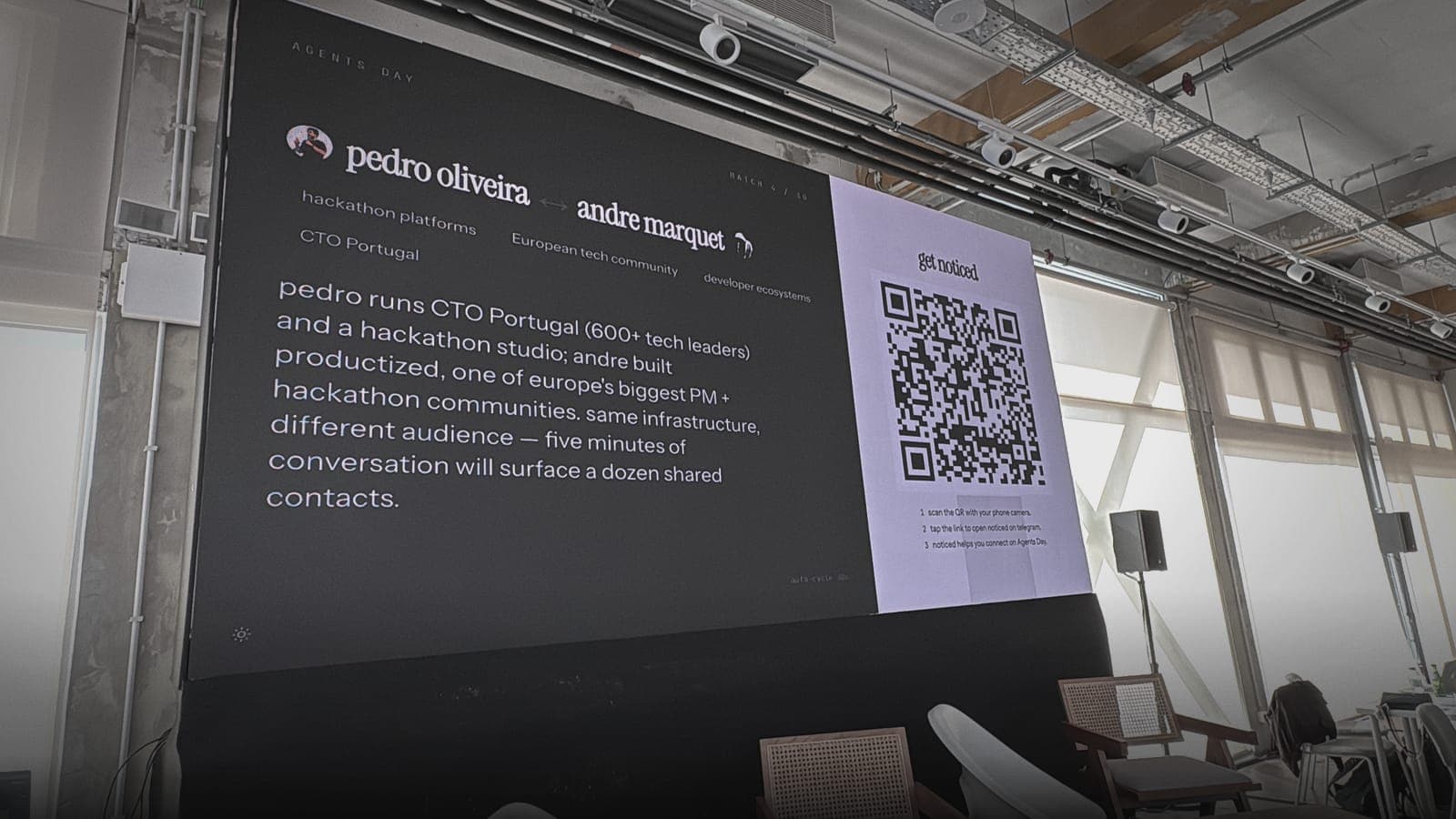
By that point we'd been onboarding builders for four hours. The QR code on the giant screen had pulled most of the room through Telegram and into noticed. The mechanic — pre-computed matches, rotating on the screen, two builders walking up to each other because we'd told them to — worked.
why this was the test
Talent co-organized Agents Day in Lisbon with Cloudflare. 100+ developers shipping AI agents. The first time noticed met anyone outside our trusted circle at real scale, and the first time we had to onboard a hundred strangers to a personal agent in the same room.
It wasn't our first attempt. Two weeks earlier we ran a quieter version of the same setup at Agents Day Braga with around 30 attendees, mostly from our extended network. Braga was where we learned that the onboarding had to be conversational, that the integrations had to live outside chat, and that you cannot ask a stranger for their LinkedIn export inside Telegram. Lisbon was where we tested whether the fixes scaled to a room three times the size, with none of the goodwill.
A live event is the opposite of every demo video. A hundred parallel onboardings, nobody has heard of the product, the attention budget per person is under a minute, and everyone in the room can see when someone else gets stuck. We learned more in three hours than in the prior three weeks.
the constraint
A personal networking agent has a chicken-and-egg problem at an event. The agent is most useful when it knows who you are, who's in the room, and what you're working on. None of that exists at minute zero. You can't onboard 100 people through a 10-minute OAuth flow each, in sequence, while the event happens around them.
So we treated onboarding as a UX problem. Get the user from "what's this?" to "I'm in" in under a minute. Fill in the rest after.
the mechanic
The trick that made the scale work: we'd already done most of the work before the doors opened.
The Lisbon event had 82 confirmed registrations on Luma the day before. We scraped the guest list, cross-referenced it against the public profiles we had indexed (GitHub for everyone, LinkedIn where we could resolve it), and generated 186 candidate matches between attendees — pairs where the skill stacks were complementary and there was a real reason for the two people to talk.
Here's one of the matches we suggested: Pedro Casaca Carvalho, an MD and public-health specialist with python and epidemiology data, paired with Ivan Pereira, CTO at Promptly Health, whose product needs to actually work in clinical environments. Their pair came up on the screen three or four times before they noticed. By the time they did, the screen had done the introduction for us; they just had to walk across the room. They did.
That's the whole product, in one moment. The substrate already knew enough about both of them to know they should talk. We just put the answer somewhere they couldn't miss it.
Then on the day, we projected a giant screen at the front of the room. On the screen, three things rotated on a 30-second loop:
- A QR code. Scan with the phone camera. Tap the link. Land in Telegram with a pre-filled
/startpayload. (Telegram caps the payload at 64 characters, which we found out the hard way — invite tokens shipped asi_<token>, every byte counted.) - A live match. Two builders side by side, complementary skills, a one-line explanation of why they should talk.
- A counter. Agents Day match N / 186.
The counter was the demand signal. Every refresh, a new pair. People in the room would point at the screen when they saw themselves. By hour two, builders were walking up to whoever was on screen with them to actually have the conversation.
The QR-to-Telegram path was the other half of the trick. We deliberately didn't ship a web onboarding flow for the event. Telegram has three properties we needed: it's already installed, it survives the scan-tap-land sequence without an auth detour, and the conversation itself becomes the onboarding. Three short messages from the agent before the first ask. Hook before request.
what worked
The QR was the whole funnel. It did the work of an app install, an email signup, and an SSO flow combined. People who scanned were inside noticed within twenty seconds. Past thirty seconds, a stranger in a noisy room has already moved on to the next thing.
Conversational onboarding scales. The agent asked one question at a time. Short bubbles, no walls of text. When we put a "connect GitHub" link in front of the user without a reason, they bounced. When the agent said "connect GitHub so I can see who you've shipped with" first, they connected.
The screen was the product demo. We never took a stage moment to pitch, never ran a slide deck. The matches were specific enough — names, photos, why-this-pair — that the room could judge whether the matching was real. People who didn't scan the QR still saw the matches and could form an opinion about whether the product worked.
Pre-seeding the room beat connecting on the spot. The 186 matches all came from the public-data pass we ran the night before. The integrations we asked attendees to connect at the door were a bonus layer — when they worked, the matches got sharper, but the baseline experience didn't depend on them. Asking 100 people to connect three accounts in a noisy room is a tax; asking them to validate matches you already generated is a gift.
Multi-channel paid off. The match notifications went out on Telegram (where the user lived for the event) and rendered on the screen (where the room lived). The same agent process emitted to both transports — no second copy of the matching logic, no second rendering pipeline. We have one multi-tenant agent harness; adding a public screen surface for the event was a separate consumer of the same substrate. Same shape as our MCP-first thinking: the work happens once in the substrate, and any surface reads from it without owning its own copy.
what broke
We're writing a longer post on this ("trust is the product" is the rough title), but the headlines:
The agent overshared in public. That 4:30pm exchange is the one we keep replaying. Someone in the public channel asked which builders in the room had NLP experience. The agent answered with three names — and included a hint about a project one of them had not announced. How do you know that? arrived a minute later. The answer was: we had indexed it from a public commit. Public to the internet is not the same as public-in-this-room. The product had treated the live group chat like a neutral query interface, and the room — full of technical builders who notice permission mismatches instantly — caught it. For a category like ours, trust is the entire product surface. If people feel watched or publicly mishandled, they stop seeing intelligence and start seeing risk.
Social tone failed under pressure. When the agent didn't know an answer, it sometimes responded with a long defensive explanation instead of a short human "I don't have that yet." A two-line failure feels honest. A six-paragraph failure feels evasive.
The agent asked for things it already had. A few users connected GitHub and LinkedIn and uploaded their LinkedIn data export, and then got asked, "what's your name?" That's the kind of bug that costs you trust in one message. Rule we added after: never ask for something you already have. Confirm what you know first.
Desktop-only steps killed mobile onboardings. LinkedIn's data export only works on desktop, but the entire Agents Day onboarding was on a phone. Anyone who picked the LinkedIn path on the spot hit a wall. Our fix was a "I'll ping you tomorrow when it's ready" pattern from the agent — making the wait part of the conversation instead of a dead end.
Telegram's internal browser ate auth sessions. Tap a link inside Telegram, lose your saved passkeys and 2FA. We've started shipping a "open in your default browser" nudge wherever auth happens, but the cleanest fix is moving the integration step out of chat entirely, into the dashboard.
the funnel
We don't have clean retention numbers yet — three weeks is too short to know who'll stick. What we do have, directionally: most of the room scanned. A meaningful fraction completed onboarding. A smaller fraction is still in the agent today. The next post in this thread will publish the full conversion ladder once we're confident the numbers won't move.
The honest read: the activation moment worked. The retention question is open.
what we'd do differently
If we ran Agents Day again next week:
- Two onboarding paths in parallel. Telegram for anyone on a phone, a single-page web flow for anyone on a laptop. We left some fraction of the room on the table by being mobile-only.
- Send the QR a day early. Half the value of the matches was that we'd pre-computed them from the public-data pass. The other half required attendees to connect their accounts on the spot — and that half was lumpy. Next time we send the QR with the day-before reminder, so the connections happen in the user's own time.
- Two screens. One showing live matches, one showing what your agent is doing right now. The second one is the demo nobody else can run.
- A volunteer at the door. Onboarding loves a human concierge for the first five users. An hour of someone's time, in exchange for the first cohort actually making it past the QR — almost always worth it.
- A scripted public-room red team before doors open. Probing the agent for the exact failure mode we hit at 4:30pm. If the answer would have leaked someone's project, we'd have known before the room did.
the bet
Two distribution bets right now: MCP and events. The MCP bet puts noticed where AI builders already work. The events bet puts noticed where the people we want as users are already gathered.
Here's the public commitment for events: if a future Agents-Day-shaped event doesn't convert at least a quarter of the room into weekly-active users within a month, we stop running them at this scale and go back to small-format dinners. The deadline matters. We'll report back with numbers.
One more lesson, the one that cost us the most: build a public-room mode before you take an agent into a public room. If you're tempted to skip it because "we'll handle it on the day," you won't. The room moves faster than you think.
We're going to keep running these. The next live event is the test of every fix above. If you want to be in the next room, join the waitlist at noticed.so.