You are on a discovery call. Halfway through, the prospect describes a pain you've heard before, almost word for word. It was someone you had dinner with six months ago. They would definitely buy this. You can't remember who.
You scroll your phone, your email, your LinkedIn. Nothing. The dinner happened. The conversation happened. The person who would have been the easiest customer of your year is somewhere in your contacts, and you've forgotten where. Your head was the only place that conversation lived, and your head moved on.
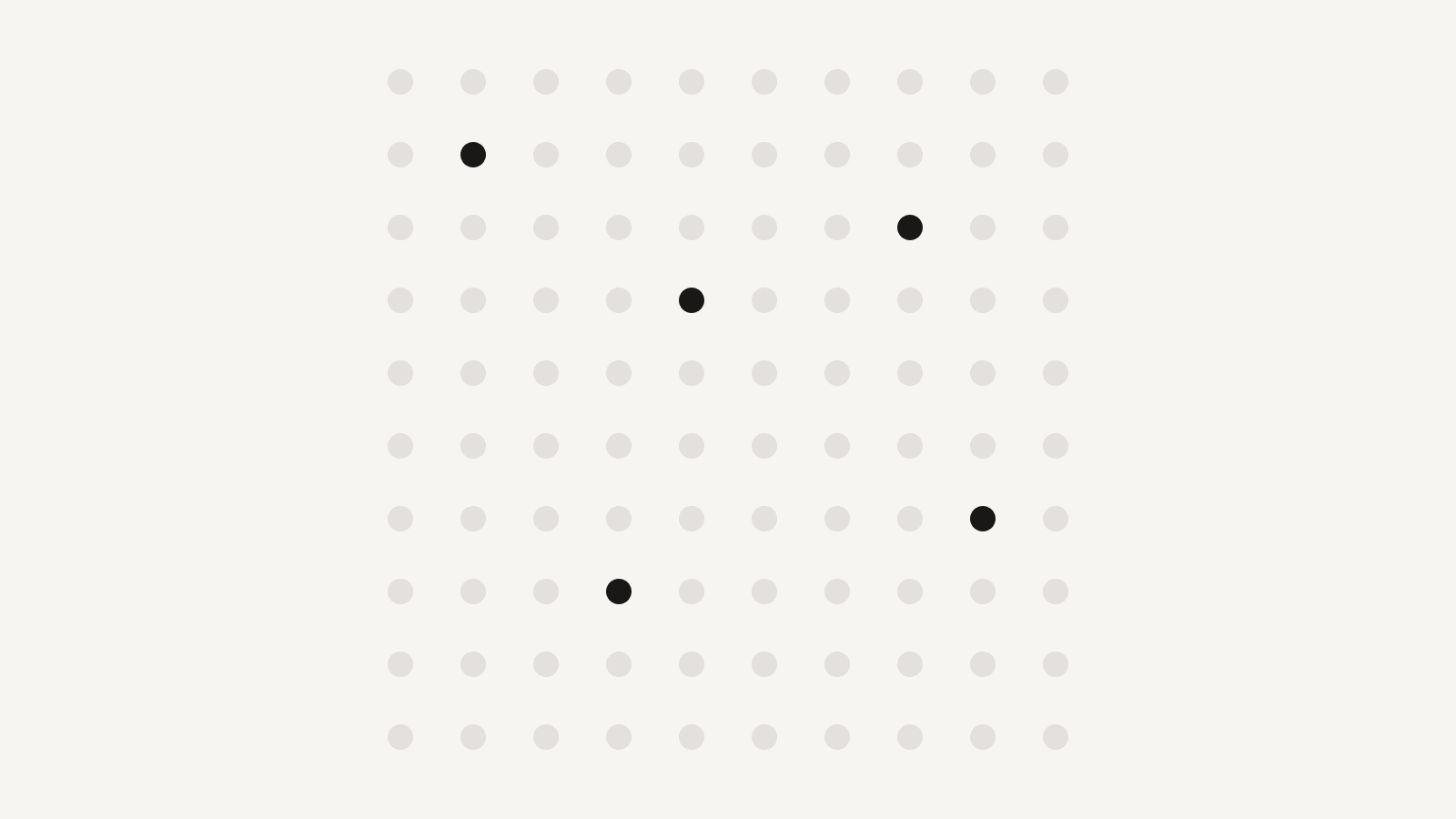
You only remember 5% of your network.
the 95% of your network you can't see
The typical founder has thousands of contacts on LinkedIn alone. Some have tens of thousands. And that number grows every week — a conference, a fundraising round, a thread on X.
But your brain doesn't grow with your network. The cognitive cap on how many people you can actually keep track of sits around 150. And that's the upper bound, not the floor; most people manage real depth on far fewer. That's Dunbar's number, the most cited estimate of how many stable relationships a human brain can maintain. A more recent 1.7M-person Twitter study found the ceiling held in the online world: even with unlimited-contact tools, people top out at 100 to 200 stable relationships. Past that, relationships decay. You forget the favor, miss the job change, lose the moment.
You can only really remember about 5% of your network.
You're only taking advantage of 5% of one of your biggest assets. The other 95% exists in your contact list, but it might as well not. You can't tell a strong tie from a stale one. The hire of your dreams becomes available, and you don't hear about it. Someone you had drinks with last spring is now buying exactly what you sell; you missed that. The contacts might still be sitting in a database, but the relationships died in your head.
The temptation is to assume the 95% is the long tail: old colleagues, random adds at events, people you barely know. But the opposite is true.
Adam Grant and Daniel Levin asked executives to rank dormant contacts by expected usefulness, defining dormant as three or more years since the last conversation. The contacts predicted to be least useful turned out to be every bit as valuable as the top-ranked ones. In a follow-up, dormant ties produced more useful advice on real work projects than current ones did. The 95% you've stopped speaking to is the same 95% sitting on advice you'd actually use.
Two other studies reinforce the point. Granovetter's 1973 paper The Strength of Weak Ties found people are 58% more likely to get a job through weak ties than close friends. And the 2022 LinkedIn study in Science, run as a randomized experiment on 20 million users, confirmed it causally: moderately weak ties are the sweet spot for career moves.
The pattern is consistent across the three studies. The 95% you can't remember isn't filler, it's the richest part of your network: dormant friends, loose ties, people who would gladly help if you happened to call. The part of your network that drives outcomes is exactly the part your brain forgets first.
your network has a memory problem
If the leverage is in the 95% you've forgotten, the obvious next question is why no tool has fixed this yet. Your brain can't hold 3,000 relationships, but a database can hold 30,000. So what's the problem?
Three specific things are missing today, and every founder feels them whether they have language for it or not.
Relationship strength.
Every warm-intro tool optimizes for the shortest path between two nodes. A 2019 LinkedIn connection and a customer you've done 14 Zooms with both count as "1". With no signal on real closeness, the algorithm falls back on what's visible: most followers, loudest in the feed. Visibility almost never tracks with whether the intro actually works. The leverage hides one layer deeper, in the next 100 ties: the second-layer people who'd happily help, if only you could see them. Today that layer is invisible, so it goes unused, and the asks that should land go cold.
Relationship context.
That discovery call moment from the opening isn't an anomaly. Most of what matters in a relationship gets said once, in passing: over dinner, on a walk, at the end of a call. CRMs require you to log it manually, and founders are too busy for that. Note-takers only catch digital meetings, one at a time, with no thread between them. Enrichment tools backfill the public fields: title, company, social handles. But the part that actually defines a relationship doesn't fit a CRM field in the first place. The dinner conversation lives in your head, until it doesn't.
Relationship signal.
A designer you've admired for years updates their LinkedIn. New role, new company. You don't see it for three weeks. By then they're already in final-round interviews at a competitor. The window for "just saw the news, let's talk" was day one. Your network generates signal constantly. Social feeds amplify what's loud, and what reaches you arrives too late. LinkedIn is a popularity contest. Crunchbase tracks funding, not people. The biggest founder breakthroughs come from catching the moment first: the right hire while they're available, the right intro window before it closes. Today that's fully dependent on luck.
What's missing is better memory for your relationships: software that can help you remember who in your network matters, what was said, and what just changed.
CRMs hold deals, calendars hold meetings, inboxes hold threads.
The relationship itself has no home: the human you've been in conversation with for a decade, the dinner where they told you what they wanted to do next, the seven dormant ties who would each take a five-minute call.
A network without memory defaults to whoever you spoke to most recently. Almost never the person you should be calling.
what if you remembered 100% of your network?
The warm intro works on the first try because the right path is visible, not just the loudest one. The dinner conversation from six months ago surfaces automatically on the discovery call, before the prospect finishes describing the pain. The designer's job change reaches you the day they update their profile, while the window is still open.
That's what a network with full memory looks like. The 5% you can hold in your head, plus the 95% you've forgotten.
This is what we're building noticed for: a system that maps your full context (LinkedIn, GitHub, Google), reads the ambient signal you already produce (calendar, email, transcripts), builds a trust-weighted graph from real interaction history, and surfaces what just changed before the window closes.
The 95% has always been there. Our job is making it visible.
Get early access to noticed.so.